
Courses for Music Majors
-
Overview
Mt SAC offers a two-year sequence of core courses for music majors, which mirrors the curriculum you would find in a university program. These credits count toward degrees and certificates here at Mt SAC, and will prepare you for successful transfer to a university.
Since we offer the music core in sequence, fall-spring, it is important that you being these classes in your first semester at Mt SAC.
Music Major Core Classes span four semesters:
In semester one, Music Theory and Musicianship are combined into a single course: Music Fundamentals (MUS 110A). Starting in semester two, students enroll in a 3-unit music theory lecture and 1-unit musicianship lab.
To progress from one semester to the next, a grade of C or better is required. For semesters two, three, and four, this means a grade of C or better is required for both courses.
Managing schedules as a music major
Music Fundamentals, Music Theory, and Musicianship are always scheduled in the morning, between 8am and 11:10am. You'll spend afternoons in ensembles, with rehearsals starting 11:30am or later. Each individual ensemble is its own class, so you may participate in as many as your schedule will allow. Most music majors take 2-3 ensembles each semester.
In addition to classes and ensembles, you will take lessons on your voice or instrument. At the college level, lessons are a course (Individual Instruction, MUS 160), which is required for completion of your degree plan, and for success as a transfer student. You will take lessons every semester that you are a major in our program.
Lessons, musicianship, and piano skills require practice. This means you'll need to schedule time every day to work independently, either in a practice room here on campus, or at home. Managing your time as a music major is challenging, but you'll get the hang of it, and we are always here to help and support you along the way!
To build a foundation for long-term success, music majors also take MUS 70, Success for Musicians, where you'll explore effective practice strategies, goal setting, artistry, motivation, and the balance between music, school, and life.
Why do you need Music Theory and Musicianship?
Music Theory and Musicianship are at the core of every college music program. Together, they help musicians understand how music works, strengthen listening skills, and build the foundation needed for performing, composing, teaching, conducting, and creating music at a high level.
At Mt. SAC, music majors complete a sequence of courses in theory and musicianship that mirrors university training programs. These courses develop skills in music reading, analysis, ear training, sight singing, rhythm, and harmonic understanding — all essential for successful transfer and long-term musical growth.
Most importantly, universities expect transfer students to demonstrate proficiency in music theory and musicianship through coursework, placement exams, auditions, or a combination of all three. Completing the sequence at Mt. SAC helps prepare students for success at the next level.
The Music Theory and Musicianship sequence is required for all music degrees and certificates at Mt. SAC. These include:
- AA-T Music (Semesters 1, 2, 3, and 4*)
- Music Studies - Level 1 Certificate (Semesters 1 and 2)
- Music Education - Level 2 Certificate (Semesters 3 and 4)
- Music Performance - Level 2 Certificate (Semesters 3 and 4)
- Jazz - Level 2 Certificate (Semesters 3 and 4)
For the best preparation and long-term success as a music major, students are encouraged to take MUS 110A rather than MUS 110. MUS 110 does not include the musicianship training needed for success in the theory sequence.
-
-
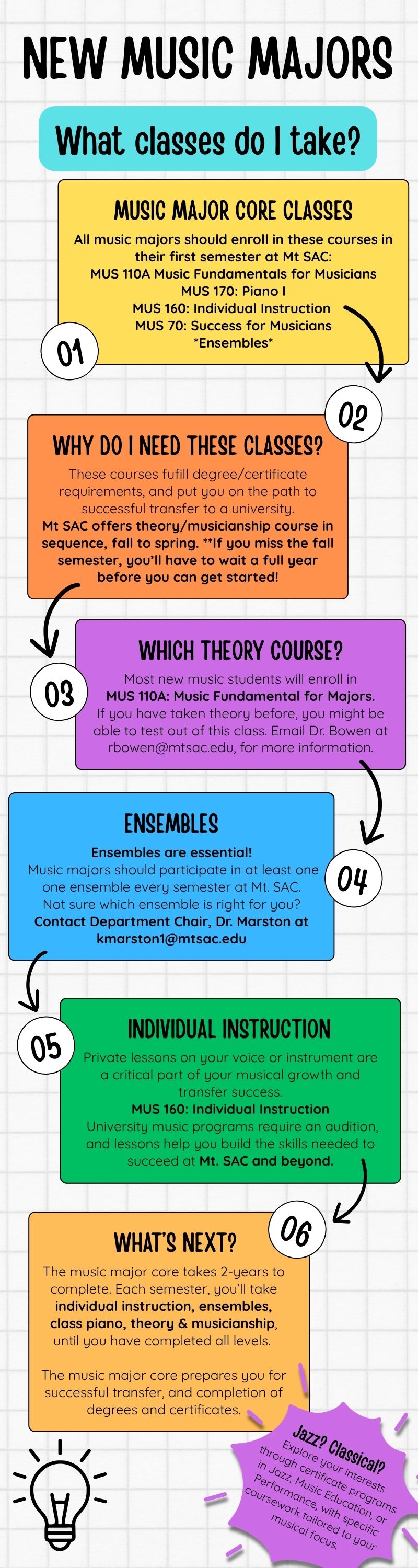 NEW MUSIC MAJORS
What classes do I take?
01 - Music Major Core Classes
All music majors should enroll in these courses in their first semester at Mt. SAC:- MUS 110A Music Fundamentals for Musicians
- MUS 170: Piano I
- MUS 160: Individual Instruction
- MUS 70: Success for Musicians
*Ensembles*
02 - Why do I need these classes?
These courses fulfill degree/certificate requirements, and put you on the path to successful transfer to a university.
Mt SAC offers theory/musicianship course in sequence, fall to spring. **If you miss the fall semester, you'll have to wait a full year before you can get started!
03 - Which Theory Course?
Most new music students will enroll in MUS 110A: Music Fundamental for Majors.
If you have taken theory before, you might be able to test out of this class.
Email Dr. Bowen at rbowen@mtsac.edu, for more information.
04 - Ensembles
Ensembles are essential!
Music majors should participate in at least one one ensemble every semester at Mt. SAC.
Not sure which ensemble is right for you?
05 - Individual Instruction
Private lessons on your voice or instrument are a critical part of your musical growth and transfer success.
MUS 160: Individual Instruction
University music programs require an audition, and lessons help you build the skills needed to succeed at Mt. SAC and beyond.
06 - What's Next?
The music major core takes 2-years to complete. Each semester, you'll take individual instruction, ensembles, class piano, theory & musicianship, until you have completed all levels.
The music major core prepares you for successful transfer, and completion of degrees and certificates.
Jazz? Classical?Explore your interests through certificate programs in Jazz, Music Education, or Performance, with specific coursework tailored to your musical focus.
One or more courses from the sequence are also required for degrees and certificates in Audio Arts/Commercial Music. These include:
- Audio Arts - Level I Certificate (Semester 1)
- Audio Arts AS (Semester 1)
- Commercial Music AS (Semesters 1 and 2)
- Commercial Music Certificate (Semesters 1 and 2)
Music Theory and Musicianship: Fall to Spring
-
The theory and musicainship sequence is scheduled so that a student who takes semester 1 in the fall can complete the sequence without interruption:

Accessible Text Description:
Music Theory and Musicianship Sequence (2-Year Schedule)The flowchart shows a two-year sequence of Music Theory and Musicianship courses.
Year 1
Fall
- MUS 110A: Music Fundamentals for Musicians
- 4.0 units
- Meets Monday and Wednesday, 8:00 AM to 11:10 AM
Spring
- MUS 120: Music Theory I
- 3.0 units
- Meets Monday and Wednesday, 8:00 AM to 9:25 AM
- MUS 125: Musicianship I
- 1.0 unit
- Meets Monday and Wednesday, 9:45 AM to 11:10 AM
MUS 110A is the prerequisite for both MUS 120 and MUS 125. MUS 120 and MUS 125 are taken concurrently (corequisites).
Year 2
Fall
- MUS 130: Music Theory II
- 3.0 units
- Meets Tuesday and Thursday, 8:00 AM to 9:25 AM
- MUS 135: Musicianship II
- 1.0 unit
- Meets Tuesday and Thursday, 9:45 AM to 11:10 AM
MUS 130 and MUS 135 are taken concurrently (corequisites). Completion of the Year 1 sequence leads to MUS 130 and MUS 135.
Spring
- MUS 140: Music Theory III
- 3.0 units
- Meets Tuesday and Thursday, 8:00 AM to 9:25 AM
- MUS 145: Musicianship III
- 1.0 unit
- Meets Tuesday and Thursday, 9:45 AM to 11:10 AM
MUS 140 and MUS 145 are taken concurrently (corequisites). Completion of MUS 130 and MUS 135 leads to MUS 140 and MUS 145.
Sequence Summary:
MUS 110A → MUS 120/MUS 125 → MUS 130/MUS 135 → MUS 140/MUS 145. Each Music Theory course is paired with the corresponding Musicianship course as a corequisite. - MUS 110A: Music Fundamentals for Musicians
-
Students also have the option of taking semester 1 in the spring. However, these students must wait till the following spring to continue on to semester 2:
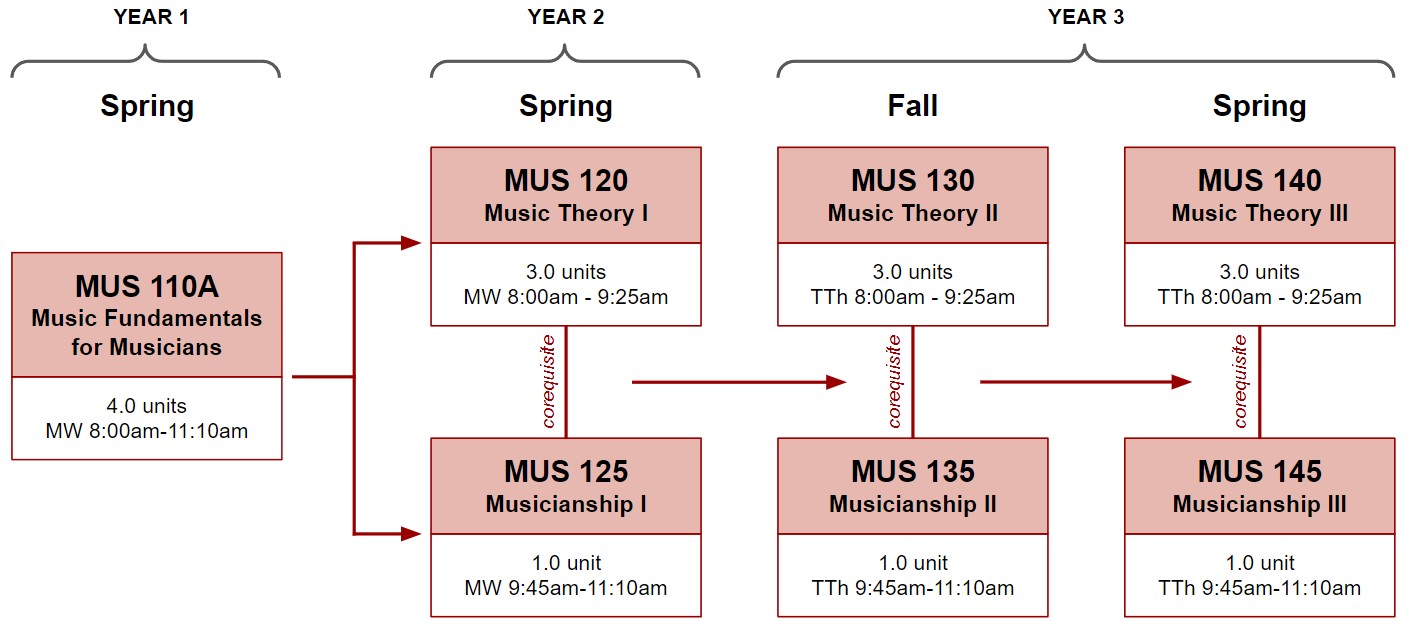 Accessible Text Description:
Music Theory and Musicianship Sequence (3-Year Schedule)
The flowchart shows a three-year sequence of Music Theory and Musicianship courses.Year 1
Spring
- MUS 110A: Music Fundamentals for Musicians
- 4.0 units
- Meets Monday and Wednesday, 8:00 AM to 11:10 AM
Year 2
Spring
- MUS 120: Music Theory I
- 3.0 units
- Meets Monday and Wednesday, 8:00 AM to 9:25 AM
- MUS 125: Musicianship I
- 1.0 unit
- Meets Monday and Wednesday, 9:45 AM to 11:10 AM
MUS 110A is the prerequisite for both MUS 120 and MUS 125. MUS 120 and MUS 125 are taken concurrently (corequisites).
Year 3
Fall
- MUS 130: Music Theory II
- 3.0 units
- Meets Tuesday and Thursday, 8:00 AM to 9:25 AM
- MUS 135: Musicianship II
- 1.0 unit
- Meets Tuesday and Thursday, 9:45 AM to 11:10 AM
MUS 130 and MUS 135 are taken concurrently (corequisites). Successful completion of MUS 120 and MUS 125 leads to MUS 130 andMUS 135.
Spring
- MUS 140: Music Theory III
- 3.0 units
- Meets Tuesday and Thursday, 8:00 AM to 9:25 AM
- MUS 145: Musicianship III
- 1.0 unit
- Meets Tuesday and Thursday, 9:45 AM to 11:10 AM
MUS 140 and MUS 145 are taken concurrently (corequisites). Successful completion of MUS 130 and MUS 135 leads to MUS 140 andMUS 145.
Sequence Summary:
MUS 110A → MUS 120 and MUS 125 → MUS 130 and MUS 135 → MUS 140 and MUS 145. Each Music Theory course must betaken with its corresponding Musicianship course as a corequisite. - MUS 110A: Music Fundamentals for Musicians
Questions? Email Department Chair, Dr. Karen Marston, at kmarston1@mtsac.edu.
